
Summary
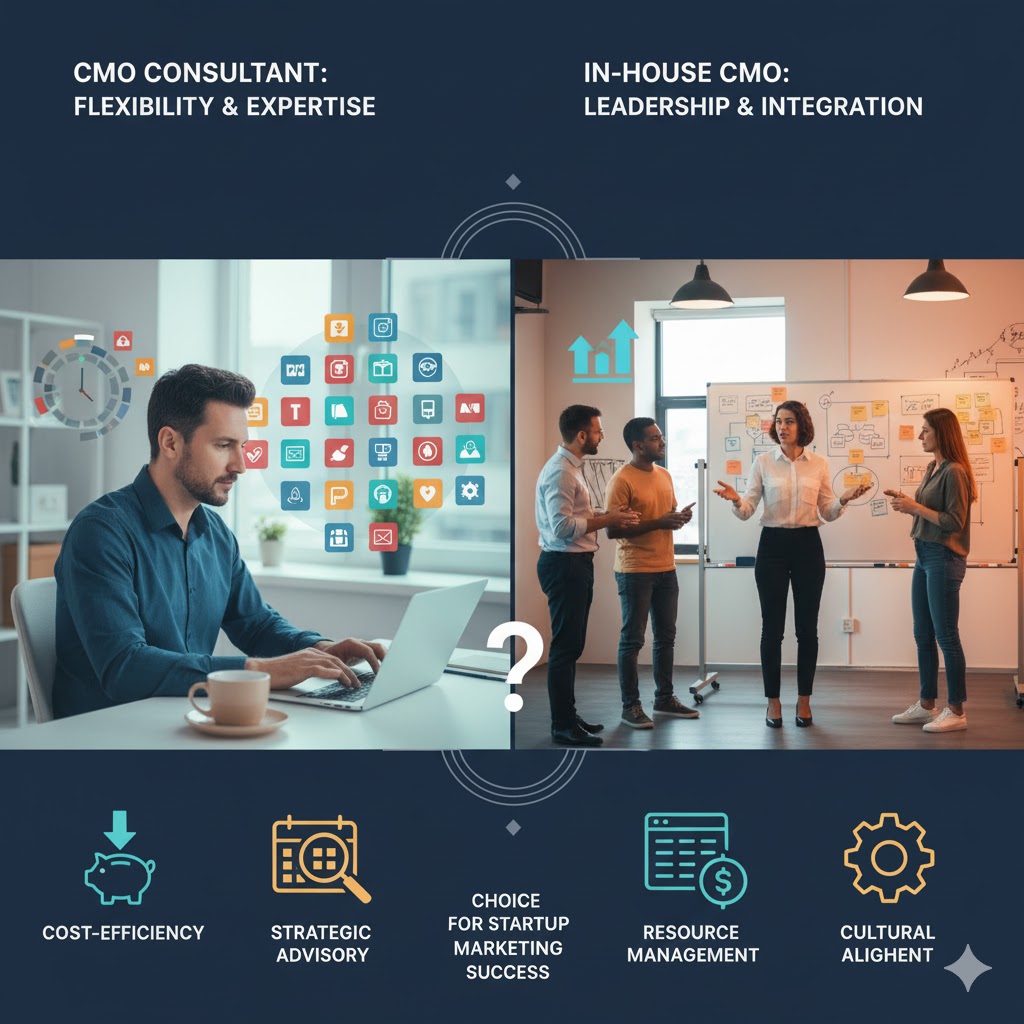
Early-stage startups often struggle with the question of whether they should hire an in-house CMO or engage a CMO consultant. Both roles bring valuable benefits, but the choice depends on factors like budget, company stage, growth expectations, and internal capabilities. A consultant offers flexibility, experience, and cost efficiency—ideal for young or bootstrapped startups. An in-house CMO provides long-term leadership, cultural alignment, and the ability to build a dedicated marketing team—often preferred by companies with stable funding and aggressive scaling goals. This detailed guide compares both options, examines how each benefits bootstrapped and VC-funded startups, and offers clarity on choosing the right model for sustainable growth.
Marketing leadership plays a crucial role in early-stage startups. Whether the goal is building a recognizable brand, generating leads, achieving product-market fit, or preparing for scale, an experienced marketing leader becomes essential sooner than many founders expect.
But here’s the challenge:
Should you hire an in-house CMO from the beginning or bring in a CMO consultant to guide strategy and execution?
For startups—especially those without a marketing-focused founder—this question carries enormous weight. Both bootstrapped and VC-backed companies must decide how to allocate resources while still giving marketing the attention it deserves.
This blog explores the differences, benefits, and ideal scenarios for choosing between a consultant CMO and a full-time in-house CMO, based on real-world startup experiences and strategic considerations.
What Is a CMO Consultant?

A CMO consultant—often referred to as a fractional CMO or CMO-as-a-Service—offers strategic marketing leadership on a part-time or contract basis. Instead of being a full-time employee, they work with multiple companies and bring diverse expertise across industries.
Their primary goal is to:
- Set strategic direction
- Fix gaps in existing marketing systems
- Provide senior-level decision-making without the full-time cost
- Guide execution teams toward scalable growth
This flexible model makes them especially useful for startups with unpredictable budgets or evolving marketing needs.
What Is an In-House CMO?

An in-house CMO is a full-time executive responsible for building and owning the entire marketing function. They work closely with the founders, integrate deeply into the company culture, and oversee long-term growth strategies.
They:
- Lead the marketing team
- Develop multi-year strategic plans
- Collaborate with product, sales, and leadership teams
- Manage branding, demand generation, customer insights, and positioning
For startups with stable funding and aggressive scaling expectations, an in-house CMO brings continuity, leadership, and alignment across departments.
CMO Consultant: Flexibility and Expertise Without Full-Time Costs
A CMO consultant provides expertise “as needed.” This format is especially relevant for early-stage companies that cannot commit to a six-figure executive salary but still require high-level marketing direction.
Let’s break down how consultants benefit different types of early-stage startups.
Advantages for Bootstrapped Startups
1. Cost Efficiency
Bootstrapped startups often face strict cash limitations. Hiring a full-time CMO involves:
- High monthly salary
- Equity
- Benefits
- Long-term commitment
A consultant offers senior expertise at a fraction of the cost. Startups can access high-level marketing strategy without burning through their financial runway.
2. Flexible Commitment
Consultants are engaged based on the startup’s needs—weekly hours, monthly sessions, or project-based work. This flexibility is ideal when revenue fluctuates or when marketing needs change rapidly.
3. Quick Wins
Experienced consultants excel at identifying high-impact opportunities. In resource-limited environments, these “quick accomplishments” are essential:
- Faster lead generation
- Clear messaging and positioning
- Market segmentation
- Launching MVP campaigns
Their ability to move swiftly helps bootstrapped startups maintain momentum without sacrificing cash flow.
Also Read: IT Consultant vs IT Analyst: Key Differences
Advantages for VC-Funded Startups
1. Broad Industry Insights
Consultants work across multiple companies and sectors. This gives them a unique perspective on:
- What works
- What fails
- How markets shift
- Proven frameworks
VC-backed startups benefit from this multi-industry experience, helping them build scalable systems from the very beginning.
2. Scaling Expertise
A consultant CMO can quickly establish:
- Marketing automation
- Reporting processes
- Funnel strategy
- Demand-generation systems
These foundational systems prepare the company for hypergrowth.
3. Objective Perspective
Because they’re not involved in internal politics or biases, consultants identify blind spots founders might miss. This external viewpoint is invaluable in fast-paced environments that require honest evaluation.
In-House CMO: Building a Strong, Long-Term Marketing Foundation
While consultants bring flexibility, hiring an in-house CMO signals a deeper commitment to marketing as a core part of the business model.
Advantages for Bootstrapped Startups
1. Cultural Consistency
An in-house CMO becomes a true part of the team:
- Sharing values
- Understanding internal dynamics
- Representing the brand authentically
This consistent alignment is powerful during early brand-building phases.
2. Long-Term Vision
Internal CMOs develop and nurture long-range strategies, improving:
- Market positioning
- Customer retention
- Brand identity
- Sustainable growth
Bootstrapped startups benefit from a leader who stays invested for years, not just months.
3. Direct Control and Collaboration
Founders often need hands-on collaboration. An in-house CMO allows:
- Faster communication
- Real-time decisions
- Tighter integration with product and operations
This is essential when every decision impacts survival.
Advantages for VC-Funded Startups
1. Leadership Stability
Investors often expect a permanent executive who can:
- Build the marketing department
- Provide predictable execution
- Guide long-term strategy
A stable marketing leader strengthens investor confidence.
2. Team Development
A full-time CMO focuses on:
- Hiring
- Training
- Managing
- Retaining marketing talent
For high-growth startups, building a strong team early becomes a competitive advantage.
3. Better Investor Communication
An in-house CMO can provide:
- Growth data
- Forecasting
- Performance documentation
- Strategic roadmaps
This transparency helps solidify relationships with investors and ensures future funding.
Key Factors to Consider Before Choosing
Every startup’s needs are different. Here are crucial questions founders should ask:
1. Do You Need Immediate Results or a Long-Term Marketing Engine?
- Consultant: Ideal for quick wins, tactical execution, and immediate direction
- In-House CMO: Best for building lasting systems and team structure
2. Is Budget Flexibility a Priority?
- Consultant: More affordable and adaptable
- In-House CMO: Larger investment but ensures long-term stability
3. Do You Need an External Perspective or Deep Internal Alignment?
- Consultant: Fresh insights, unbiased analysis
- In-House CMO: Deep integration with culture and product
Making the Right Choice for Your Startup
No solution works for every startup. The decision depends on:
- Stage of growth
- Available budget
- Internal skill gaps
- Marketing urgency
- Funding situation
A Hybrid Approach
Many startups start with a consultant to:
- Set initial marketing direction
- Establish systems
- Test channels
Then transition to an in-house CMO once revenue and operations stabilize.
This model lowers risk while ensuring continuity.
Conclusion
Choosing between a CMO consultant and an in-house CMO is not a matter of which option is universally “better.” It’s about selecting the right fit for your current stage, budget, and goals.
A CMO consultant delivers:
- Flexibility
- Speed
- Diverse experience
- Lower cost
An in-house CMO offers:
- Stability
- Long-term leadership
- Cultural alignment
- Team-building capabilities
For many early-stage startups, beginning with a consultant is the safest low-risk option. As the company grows, hiring an in-house CMO becomes more practical and beneficial.
The right marketing leadership—whether fractional or full-time—should always support your startup’s broader vision and fuel sustainable growth.
FAQs
What is the main difference between a CMO consultant and an in-house CMO?
A consultant provides flexible, part-time strategic expertise, while an in-house CMO is a full-time executive responsible for leading long-term marketing efforts.
Which option is more cost-effective for early-stage startups?
A CMO consultant is typically more affordable because startups only pay for the hours or scope needed.
When should a startup consider hiring an in-house CMO?
When the company has stable funding, needs long-term leadership, and plans to build a full marketing team.
Can a startup use both models?
Yes. Many begin with a consultant and later transition to a full-time CMO as they scale.
Do VC-funded startups prefer consultants or in-house CMOs?
VC-funded companies often start with consultants for speed but eventually hire in-house CMOs for stability and investor confidence.
What type of startup benefits most from a consultant?
Bootstrapped startups with limited budgets or companies that need fast strategic execution benefit the most.

I’m Debabrata Behera, a passionate blogger sharing insights, tips, and stories across diverse topics. Through my writing, I aim to inspire, inform, and connect with readers worldwide.