

Summary
Technology is now the center of business operations, customer experience, and competitive advantage. But when a company faces leadership gaps in IT or rapidly evolving technology demands, the organization cannot afford to slow down. That is where an Interim Chief Information Officer (Interim CIO) steps in. An Interim CIO is a temporary but highly experienced technology leader who rapidly assesses IT performance, stabilizes systems, and drives modernization or transformation during periods of transition or change.
This detailed guide explains what an Interim CIO does, why organizations hire one, and how this role compares to a permanent Chief Information Officer. You’ll also learn signs that indicate a business urgently needs an Interim CIO, key benefits of bringing one onboard, and what to expect throughout their engagement.
Technology Leadership Has Never Been More Critical
Every organization today is, in some form, a technology-driven company. IT is no longer just a support function. It is essential for:
- Operational efficiency
- Data-driven decision-making
- Customer service and digital experience
- Cybersecurity and risk protection
- Automation and scalability
- Innovation and market differentiation
Without a senior executive guiding the IT strategy, companies face:
- Security vulnerabilities
- High infrastructure costs
- Slow digital transformation
- Poor system integration and performance
- Disconnected processes and teams
- Stagnant growth
That’s why the role of a Chief Information Officer (CIO) has become mission-critical across industries—from manufacturing and finance to healthcare and technology.
But what happens when a CIO suddenly resigns? When a company grows faster than its digital capabilities? Or when a major IT transformation cannot wait months for a full-time executive search?
The answer is to bring in an Interim CIO.
What Is an Interim Chief Information Officer?

An Interim CIO is a seasoned technology executive who temporarily steps into the CIO role, fully responsible for IT leadership and transformation. Their job is to stabilize and elevate an organization’s technology capability during times of disruption or urgency.
Typically, an Interim CIO serves for a defined period such as:
- 6 months
- 9 months
- 12–18 months depending on complexity
Unlike consultants who provide recommendations, Interim CIOs are hands-on operators with authority and accountability over:
- IT strategy
- Digital transformation
- Infrastructure performance
- Cybersecurity
- Technology governance
- Team leadership and development
They ensure continuity today while creating a technology roadmap for future success.
Why Businesses Hire an Interim CIO: Common Situations
Organizations rely on Interim CIOs to protect business continuity while accelerating transformation. The need becomes urgent when:
- A CIO unexpectedly leaves or retires
- New leadership wants new technology direction
- Rapid growth reveals infrastructure gaps
- A digital transformation has stalled
- A merger or acquisition requires IT integration
- A company faces cybersecurity threats
- Technology debt harms operations and customer experience
Technology issues can quickly escalate into business-wide crises. Interims are deployed fast—often within days—not months.
Interim CIO vs. Permanent CIO: Key Differences
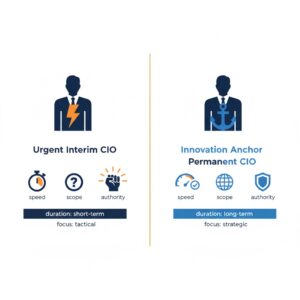
Although both lead the IT function, their purpose, timeline, and execution style differ.
1. Duration and Commitment
Interim CIO
Short-term assignment focused on stabilizing and advancing IT during transitions.
Permanent CIO
Ongoing leadership role responsible for long-term strategy and evolution.
2. Speed and Execution Style
Interim CIO
Expected to assess and act quickly, delivering results in weeks, not quarters.
Permanent CIO
Takes a more measured pace that aligns with the company’s multi-year goals.
3. Focus and Mandate
Interim CIO roles are typically brought in to:
- Resolve urgent IT issues
- Lead turnarounds or transformations
- Upgrade systems and technology stack
- Reduce cybersecurity risks
- Improve internal IT performance and reliability
A permanent CIO focuses on:
- Future innovation
- Cultural alignment and talent development
- Maintaining long-term technology advantage
4. Cost and Risk Profile
Interim CIO
Short-term investment — avoids long-term payroll, equity, and severance costs.
Permanent CIO
Higher overall compensation package and long-term financial commitment.
Also Read: How to Find the Right CEO to Lead Your Company to Success
5. Decision-Making Style
Interim CIO
Often uses bold and objective leadership — not influenced by internal politics.
Permanent CIO
Works within existing culture, relationships, and historical constraints.
Roles and Responsibilities of an Interim CIO
The core expectation is to deliver rapid and meaningful improvements.
Below is a detailed breakdown of key responsibilities:
Technology Assessment
- Audit current systems and processes
- Identify performance gaps and cybersecurity weaknesses
- Evaluate IT spend and optimization opportunities
Strategic Direction
- Align IT roadmap with organizational goals
- Prioritize technology investments based on ROI
- Plan digital transformation initiatives
Operational Stabilization
- Fix downtime issues and system instability
- Improve IT service delivery and productivity
- Strengthen vendor management and SLAs
Cybersecurity and Risk Mitigation
- Implement modern security tools and compliance standards
- Reduce vulnerability exposure
- Strengthen data privacy and breach response capability
IT Governance and Budget Management
- Ensure better financial control and transparency
- Optimize IT costs through smarter sourcing and cloud utilization
Leadership and Team Building
- Mentor IT managers and develop next-generation leaders
- Address talent or capability gaps quickly
- Improve collaboration with other departments
Technology Modernization
- Cloud strategy and digital tools evaluation
- Legacy system replacement planning
- Improving data architecture and business intelligence
Benefits of Hiring an Interim CIO
Organizations experience major advantages when bringing in a temporary CIO:
- Fast deployment of expert leadership
- Immediate decision-making and execution
- Fresh, unbiased perspective on IT performance
- Stability during leadership transition
- Reduced operational risk with expert oversight
- Stronger cybersecurity and compliance controls
- Improved IT team performance and morale
- Technology aligned to business growth
Their mission is not simply to “maintain” IT but to elevate it.
Challenges to Consider When Hiring an Interim CIO
As with any change in leadership, success requires clear alignment:
- Defining scope and authority upfront
- Cultural acceptance from internal teams
- Effective communication to stakeholders
- Clear KPIs for transformation progress
With proper onboarding and executive sponsorship, these challenges can be well-managed.
Signs Your Organization Needs an Interim CIO Now
You likely need an Interim CIO if any of the following are true:
- The company has experienced a major cybersecurity incident
- IT issues are blocking business performance
- Teams are frustrated with outdated systems
- A merger or acquisition requires fast IT integration
- The CEO is making too many operational technology decisions
- Digital transformation feels slow, costly, or chaotic
- The company cannot afford a long hiring delay
- IT spend is high but ROI is unclear
If IT is slowing down business progress instead of enabling it, timing is critical.
Can an Interim CIO Become the Permanent CIO?
It’s possible — but often not the goal.
Most Interim CIOs are engaged to:
- Maintain objectivity
- Make difficult decisions without bias
- Prepare for a smooth handoff to a future permanent CIO
However, if cultural fit and performance align, some organizations may choose to extend the role permanently.
The key is that the Interim CIO serves immediate needs while building the foundation for long-term success.
Industries That Commonly Use Interim CIOs
Interim CIO leadership is especially common in sectors experiencing rapid digital change, including:
- Healthcare and life sciences
- Financial services and insurance
- Retail and e-commerce
- Manufacturing and logistics
- Technology and SaaS businesses
- Education and government agencies
Any organization where technology impacts performance can benefit from temporary skilled leadership.
How an Interim CIO Leaves a Lasting Impact
Even though their role is temporary, the outcomes endure.
Positive outcomes include:
- Modern and scalable infrastructure
- Stronger security and compliance posture
- Higher efficiency and improved cost control
- Better customer experience and digital capabilities
- Empowered and trained IT teams
- Technology culture that supports growth
In short: temporary role, permanent transformation.
Conclusion
Technology changes fast, and companies cannot afford to wait months to solve urgent IT challenges or fill a leadership vacancy. An Interim Chief Information Officer provides the expertise, speed, and decision-making power needed to protect the business and accelerate transformation.
While a permanent Chief Information Officer focuses on long-term innovation, an Interim CIO focuses on immediate stability and impact — ensuring the organization continues moving forward confidently during transition.
Whether your organization is experiencing operational breakdowns, cybersecurity threats, or rapid growth, bringing in an Interim CIO can be the difference between falling behind and thriving in a digital-first world.
FAQs
What does an Interim CIO do?
An Interim CIO temporarily leads the technology function, stabilizes IT operations, improves cybersecurity, and drives strategic digital transformation during leadership changes.
How long does an Interim CIO stay?
Most engagements last from 6 to 18 months depending on business needs, urgency, and scope of transformation.
Is an Interim CIO full-time?
Yes. Unlike fractional technology leaders, Interim CIOs fully dedicate themselves for the duration of the contract.
Why hire an Interim CIO instead of a consultant?
Consultants offer recommendations. An Interim CIO leads teams and executes real change with accountability for outcomes.
When is an Interim CIO needed?
When IT is failing, when a CIO abruptly leaves, during mergers or rapid scaling, or when cybersecurity threats create serious risk.
Can an Interim CIO become permanent?
Yes, but it is not the typical intention. Their independence allows them to take action without internal political influence.