
Summary
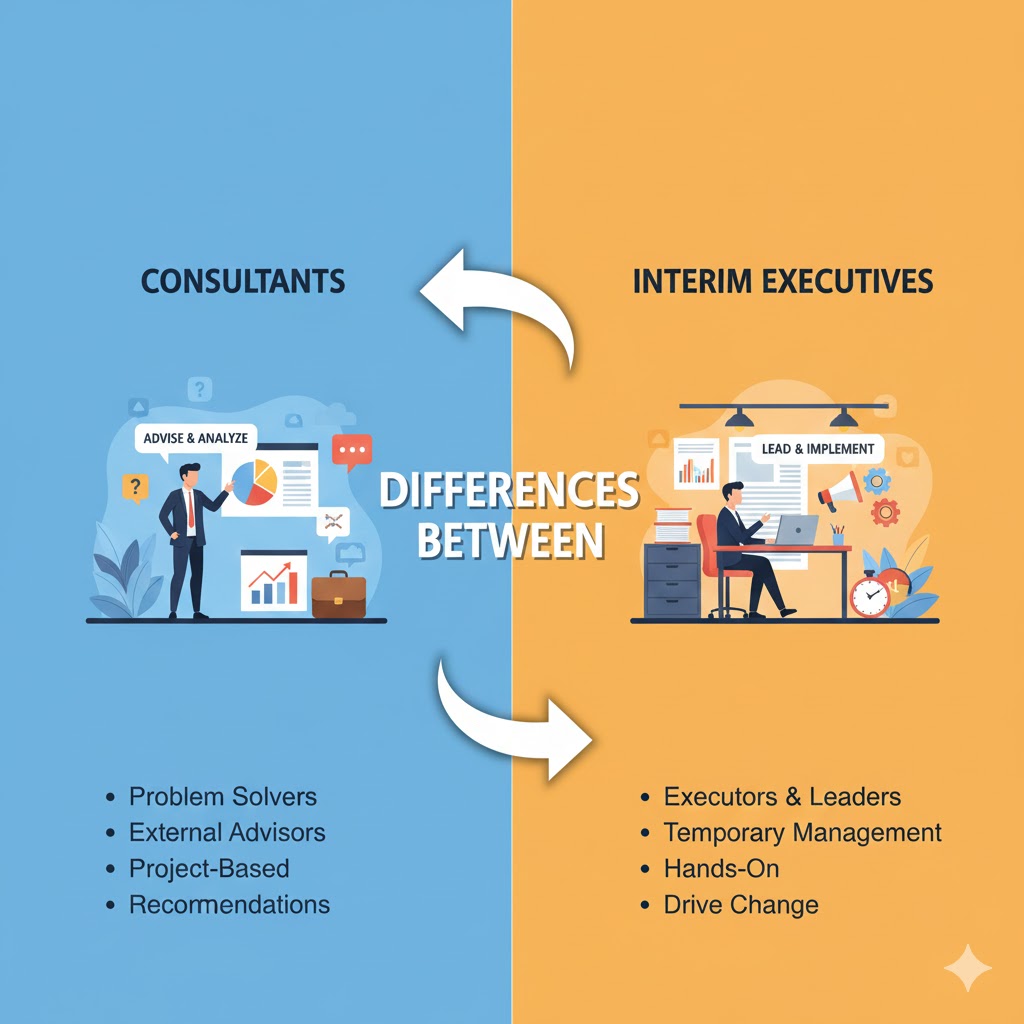
Organizations today face constant uncertainties — leadership gaps, transformation demands, technology disruption, operational inefficiencies, and competitive pressures. When expertise is needed quickly, businesses often find themselves choosing between interim executives and consultants. While both provide valuable skills and strategic insight, the difference between a consultant and an interim manager lies in execution, authority, and accountability.
Consultants advise from the sidelines, offering strategic recommendations. Interim executives, on the other hand, step into leadership roles with the authority to implement real change and deliver measurable results.
This complete comparison guide explains the roles, advantages, disadvantages, and best-fit situations for each — helping you make the best decision for your organization’s goals.
External expertise has become a necessity rather than a luxury. In a rapidly changing market, businesses can’t afford to experiment or waste time planning without action.
When leaders search for solutions, common questions arise:
- What is the difference between an interim executive and a consultant?
- Do I need advice or hands-on transformation?
- What’s the best consultant alternative for execution-heavy challenges?
This guide breaks down when to choose each, how they operate inside your business, and which will drive the ROI you need — especially during critical times of transition, crisis, or growth.
What Consultants Do: A Quick Overview
A consultant is an external advisor hired to analyze problems, offer expert recommendations, and share specialized knowledge.
Typical consultant responsibilities include:
✔ Market and competitive analysis
✔ Operational and strategic assessments
✔ Data-driven recommendations
✔ Technology audits and transformation roadmaps
✔ Identifying inefficiencies and offering solutions
Consultants excel at:
- Bringing fresh perspectives
- Conducting deep analytical research
- Delivering detailed presentations and reports
The global consulting industry is massive — expected to exceed $371 billion by 2025 — proving how valuable advisory expertise continues to be.
Consultant limitations
Consultants rarely oversee execution. They typically:
- Do not take on leadership authority
- Do not manage teams
- Do not control outcomes
- Step out once the final report is delivered
This often leads to what many businesses call “the strategy-execution gap.”
A well-known reality:
Up to 70% of consulting recommendations fail to fully execute, mostly due to lack of ownership and implementation support.
Consultants tell you what to do — but not how to make it happen effectively.
What Is an Interim Executive?

An interim executive (or interim manager) is a highly experienced business leader who joins an organization on a temporary basis — usually 3 to 12 months — to lead critical initiatives or fill a senior vacancy.
Key characteristics
✔ Hands-on leadership inside your company
✔ Authority to make decisions and drive execution
✔ Full accountability for performance outcomes
✔ Usually hired during significant change or uncertainty
Unlike consultants, interim executives embed themselves into your culture and operations.
They are not observers.
They are operators.
Common interim roles
- Interim CEO
- Interim COO
- Interim CFO
- Interim CMO
- Interim CIO/CTO
- Interim HR Director (Chief People Officer)
The interim management segment is smaller than consulting, but growing quickly — projected to reach $4.5 billion by 2030, thanks to market demands for agile and rapid execution-based leadership.
Why businesses love interim leaders
They:
- Step in fast
- Bring immediate credibility
- Accelerate transformation
- Deliver measurable impact
Interim executives are often described as consultant alternatives for organizations that need more than advice — they need action.
Key Differences Between Consultants and Interim Executives
Here is a simplified breakdown of interim executive vs consultant differences:
| Criteria | Consultants | Interim Executives |
| Primary Role | Analysis, insights, recommendations | Leadership, execution, and operational ownership |
| Team Authority | None | Full authority to lead teams |
| Engagement Focus | Strategy and advisory | Implementation and transformation |
| Success Measure | Deliverable or report | Tangible results (KPIs, financial gains) |
| Time Frame | Short-term | Medium-term (months, not weeks) |
| Accountability | Ends after presentation | Responsible for results they deliver |
| Internal Position | External advisor | Temporary senior executive |
In simple terms:
➡ Consultants propose
➡ Interim executives deliver
One creates the blueprint.
The other builds the house.
When to Choose a Consultant vs. an Interim Executive
✔ Hire a Consultant When:
You need:
- Specialist advice
- A new strategic direction
- Market or operational insight
- Performance audits or feasibility studies
Consultants are ideal when:
- You are planning a major initiative
- You need objective, external thinking
- You have internal leadership to execute the recommendations
Use Case Example:
A business wants to compare CRM platforms and map a digital transformation strategy.
A consultant will analyze and recommend the best solution.
Also Read: The ROI of Hiring a Fractional CMO: 7 Measurable Benefits
✔ Hire an Interim Executive When:
You need:
- Leadership in place NOW
- Execution, not just ideas
- Someone who can own the outcome
Interim leaders excel during:
- Sudden leadership departures
- Mergers, acquisitions, integrations
- Turnarounds or crisis management
- Scaling operations and growth initiatives
Use Case Example:
A company’s sales pipeline collapses.
Hiring an interim CRO or interim CMO can rebuild revenue systems and lead teams directly to restore growth.
How to Choose Between an Interim Executive and a Consultant
Ask yourself three critical assessment questions:
Do you need analysis or immediate action?
- Strategy clarity needed → Consultant
- Execution needed → Interim executive
Is leadership missing?
- If yes → Interim executive
- If internal leaders exist → Consultant may work
What results do you expect?
- Presentation & roadmap → Consultant
- KPIs and financial outcomes → Interim executive
A helpful decision rule:
“If the challenge requires culture change or team accountability, you need an interim executive — not a consultant.”
Signs You Hired the Wrong Type of Help
Indicators a Consultant Was a Bad Fit
- You received a strategy — but nobody is implementing it
- Internal resistance to recommendations
- Productivity hasn’t improved
- You still have the same challenges months later
45% of consultant-driven plans fail due to operational disconnects.
Indicators an Interim Executive Was a Bad Fit
- The real need was strategic design, not execution
- Team disruption from unnecessary process changes
- Leadership overreach or excessive speed
Misalignment early can cost time and money — quick course correction is critical.
Why Execution Matters More Than Advice
The biggest difference between interim executives and consultants comes down to one truth:
Execution is what drives business survival and profitability.
Data supports this:
- Interim executives often generate 20–30% higher ROI than consultants because the work results in real operational improvements.
- Organizations facing disruption need leaders who can act, not just advise.
Case Example
A tech startup struggling with revenue growth engaged an interim CMO.
Within 6 months, they achieved:
- 20% revenue increase
- Stronger market positioning
- Clear brand messaging and sales alignment
That success came not from advice, but from execution through leadership.
Today’s business world rewards speed, agility, and results — all strengths of interim management.
Market Trends: Interim Management vs. Consulting
| Industry | Market Size | Growth Outlook |
| Consulting | $371B+ globally | Steady but slower |
| Interim Executives | $2.5B → expected $4.5B by 2030 | Rapid upward trend |
Why interims are gaining popularity:
- Rising economic uncertainty
- Leadership turnover and gaps
- Digital transformation urgency
- “Just-in-time” leadership preference
Organizations are shifting from research-first to action-first strategies — driving demand for interim leaders.
Conclusion
There is no universal winner in the interim executive vs consultant debate.
Both provide value — when used correctly.
Consultants are best for:
- Strategy development
- High-level analysis
- Specialized expertise projects
Interim executives are best for:
- Urgent leadership needs
- Business transformation
- Crisis response
- Revenue and performance improvement
The real question is:
Do you need someone who gives advice,
or someone who fixes the problem?
If your business needs action, accountability, and immediate results, an interim leader will deliver the performance impact consultants can’t provide alone.
FAQs
What is the main difference between a consultant and an interim executive?
A consultant provides strategy and recommendations; an interim executive joins the company and leads implementation with real accountability.
When should I hire a consultant over an interim manager?
Hire a consultant for research-based projects where internal leadership can execute the recommendations.
How do I know if I need an interim executive?
If execution is failing, leadership is missing, or the situation is urgent — an interim will deliver immediate results.
Are interim executives more expensive than consultants?
Not necessarily. Interims often deliver better ROI because they directly improve KPIs, operations, and revenue performance.
Can interim executives and consultants work together?
Yes. Many organizations choose consultants for strategic development and interims to lead operational rollout.
What is a consultant alternative for companies that need implementation?
An interim executive — they serve as leaders who execute rather than simply advise.