
Summary
A business turnaround is one of the most complex challenges any organization can face. When performance declines, cash dries up, or market disruptions hit, survival depends on fast and decisive action. The turnaround process addresses this crisis with clear strategies to stabilize finances, restructure operations, and restore profitability. But not all turnarounds succeed — and the difference often comes down to leadership and execution.
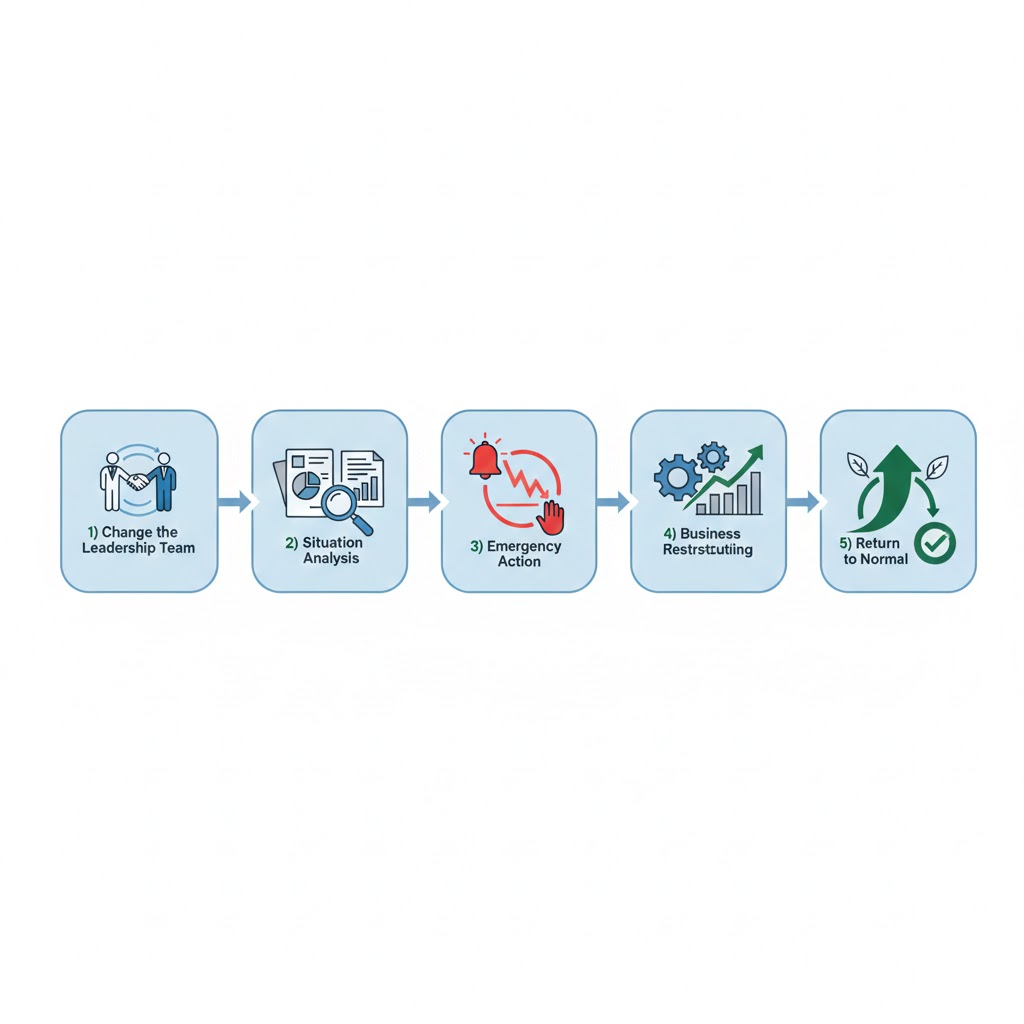
This guide breaks down the five stages to managing successful turnarounds, explaining what each step involves, why it matters, and how turnaround specialists create value for companies under pressure. Whether a company suffers from mismanagement, cash flow crises, or poorly executed growth, these steps can significantly increase the chance of recovery.
Organizations rarely decline due to a single event. Instead, performance issues build over time until the company reaches a breaking point.
Research by the Association of Insolvency and Restructuring Advisors found that only 9% of corporate failures are caused by uncontrollable external factors such as economic conditions.
The other 91% are linked to mismanagement, including:
- Ineffective leadership style
- Poor strategic direction
- Underdeveloped talent and weak team performance
- Inability to win and retain customers
- Lack of clear financial controls
- Unmanaged, chaotic growth
Turnaround management requires acknowledging what led to the decline — then applying strong leadership and a structured plan to correct it.
The goal of the turnaround process is simple:
Stabilize the company today, rebuild profitability, and prepare for long-term growth.
Achieving that goal requires five critical stages.
The Role of Turnaround Specialists
When a business is in distress, existing leadership may struggle to fix problems they helped create. That’s where turnaround specialists come in.
There are two main types:
- Turnaround Practitioners
- Often step directly into leadership roles such as CEO or Chief Restructuring Officer
- Take operational control and decision-making authority
- Turnaround Consultants
- Advise the existing management team
- Provide diagnostic insight and strategic recommendations
While both offer value, practitioners with hands-on leadership experience typically excel in rapid crisis resolution because they make decisions directly rather than advising from the sidelines.
Their mission:
Make the business valuable again — for lenders, investors, customers, and future buyers.
The Five Stages of a Successful Business Turnaround
Stage 1: Change the Leadership Team

Effective turnaround management begins with leadership. A failing business needs a leader who can:
- Make difficult decisions quickly
- Rebuild organizational confidence
- Align teams with a turnaround strategy
- Communicate with stakeholders clearly and firmly
This often means replacing the CEO and key executives responsible for the decline. Bringing in fresh leadership with restructuring expertise provides credibility and restores accountability.
Actions during Stage 1:
- Remove management blocking necessary change
- Reevaluate board oversight and restructure if needed
- Bring in leaders skilled in crisis management and transformation
- Establish immediate authority and trust among teams and lenders
A turnaround leader’s primary objective is not to maintain the old culture — it is to reset the direction of the organization.
Stage 2: Situation Analysis

Now that leadership is in place, the team must answer essential questions:
- Is the business worth saving?
- What caused the crisis?
- Are operations financially viable?
- What products or markets are worth retaining?
- How long can the company survive on current cash?
A 13-week cash flow analysis is a standard tool to provide early visibility into survival timelines.
The assessment phase also includes:
- Identifying profitable vs. loss-making business segments
- Reviewing pricing, margins, and customer acquisition issues
- Understanding operational bottlenecks
- Determining break-even points
The output is a preliminary action plan that identifies:
- What must change
- How quickly change must occur
- Where cash can be preserved
- Which units must be fixed or shut down
Clear, fact-based decisions begin here.
Stage 3: Emergency Action

This is the crisis containment stage. The goal is simple:
Stop cash hemorrhage and stabilize operations immediately.
Time is the most valuable resource in a failing company. Decisions must be swift.
Key corrective actions:
- Centralize cash management and freeze unnecessary spending
- Collect overdue receivables and renegotiate payables
- Secure short-term financing if viable
- Sell non-core or unprofitable assets
- Downsize to restore financial balance quickly
Workforce restructuring is often necessary. It should be done:
- Once
- Quickly
- Fairly
Repeated layoffs break morale and productivity.
This stage focuses on achieving breakeven operations and communicating a clear plan to stakeholders so confidence can start rebuilding.
Stage 4: Business Restructuring

Once the organization is secure, it’s time to repair the business model and restore profit.
Objectives of this stage:
- Improve profitability in all retained business lines
- Redesign workflow and eliminate inefficiencies
- Strengthen pricing strategies and margin performance
- Rebuild relationships with customers and suppliers
- Restructure long-term debt to support future growth
Turnaround specialists emphasize:
- Return on Investment (ROI)
- Return on Assets (ROA)
- Positive cash flow from operations
Employee participation becomes essential here. Teams can identify inefficiencies that leaders may overlook, creating a culture of ownership.
Growth strategies include:
- Selling current products to new customer segments
- Developing new offerings for existing customers
- Retaining top-performing talent
The result is a financially viable business with a focused operational structure.
Also Read:What Are The Differences Between Executive and Non-Executive Directors?
Stage 5: Return to Normal

With profitability restored, the organization must ensure this success is sustainable.
Focus areas in the final stage:
- Institutionalize the disciplined culture
- Replace crisis mode with performance-based management
- Implement ongoing training and leadership development
- Maintain strong working capital and liquidity
- Strengthen competitive advantages to support growth
- Improve long-term financing arrangements
The turnaround succeeds fully when the company:
- Has regained stakeholder confidence
- Operates with improved management systems
- Demonstrates positive performance metrics consistently
This is when organizations can consider strategic expansion — from new product launches to market growth and reinvestment.
Conclusion
A successful business turnaround does not happen by accident. It requires:
- Courage to change leadership
- Fact-based analysis
- Decisive, emergency actions
- Strategic restructuring
- A culture focused on long-term performance
Following these five stages to managing successful turnarounds creates clarity and direction at a time when uncertainty threatens the company’s future.
Businesses that commit to this structured turnaround process significantly increase their chance of recovery — and position themselves for renewed growth, improved trust, and a stronger future.
FAQs
What is a business turnaround?
A business turnaround is a structured process used to rescue an organization facing financial decline or operational distress, restoring profitability and long-term health.
When should a company bring in a turnaround specialist?
When performance issues escalate into cash shortages, missed targets, loss of customer confidence, or leadership breakdown — and internal teams cannot fix the issues alone.
How long does the turnaround process take?
Timelines vary based on severity, but many turnarounds take 6 to 18 months from initial intervention to profitability stabilization.
Is changing leadership always necessary in a turnaround?
Often, yes. Since mismanagement is a primary cause of failure, bringing in leaders with crisis management expertise is critical for success.
What is the biggest misconception about turnarounds?
That they are simply cost-cutting exercises. Cutting alone cannot fix a broken business model — transformation and value creation are essential.
Can all businesses be saved?
No. Some are beyond recovery due to market decline, excessive debt, or irreparable financial damage. The early analysis phase determines viability.