
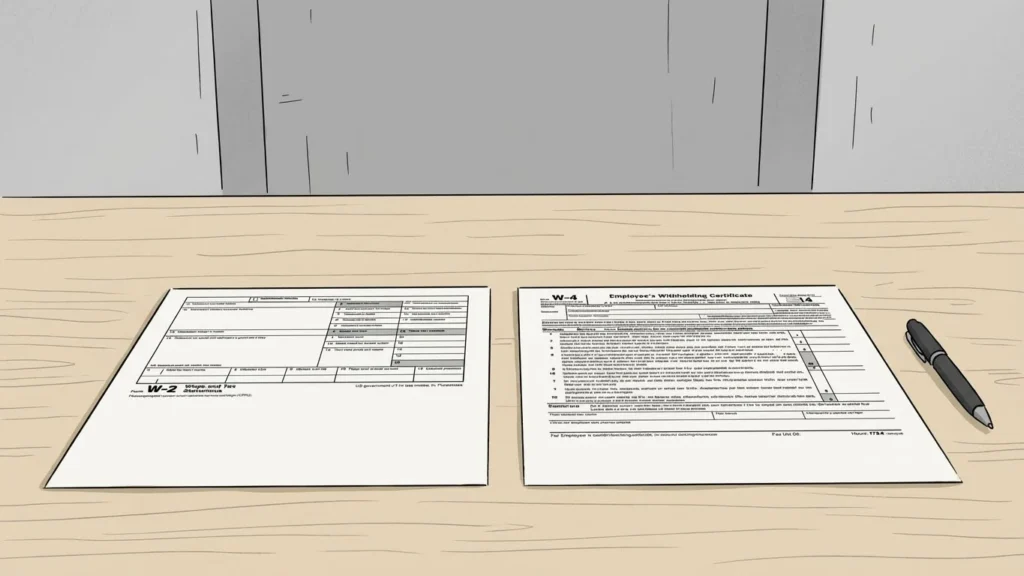
In payroll management, tax forms are essential to ensure employees are paid correctly and taxes are calculated accurately. Two of the most commonly used payroll-related forms in the United States are W-2 and W-4. Although their names sound similar, they serve completely different purposes and are used at different stages of the employment and payroll process.
Many employees and even employers confuse W-2 and W-4, which can lead to incorrect tax withholding, payroll errors, and compliance issues. Understanding how these forms work, what information they contain, and how they are connected is critical for smooth payroll operations. This blog clearly explains W-2 vs W-4, their key differences, and their role in payroll, in a structured and easy-to-understand way.
What Is a W-2 Form?
A W-2 form, officially known as the Wage and Tax Statement, is a year-end document that reports how much an employee earned and how much tax was withheld during the calendar year. Employers are legally required to issue a W-2 to every employee who received wages during the year.
The W-2 is a reporting form, not a decision-making form. It does not affect payroll calculations during the year. Instead, it summarizes all payroll activity after the year has ended. Employees use the W-2 to file their income tax returns, and employers submit copies to the Internal Revenue Service and, where applicable, to state and local tax authorities.
Information Included in a W-2
A W-2 includes detailed information about an employee’s earnings and tax deductions for the year.
- Total wages, salaries, tips, and other compensation
- Federal income tax withheld
- Social Security wages and Social Security tax withheld
- Medicare wages and Medicare tax withheld
- State and local wages and taxes withheld, if applicable
- Employer details, including business name, address, and employer identification number (EIN)
This information helps tax authorities verify income and tax payments and allows employees to accurately file their tax returns.
What Is a W-4 Form?
A W-4 form, officially called the Employee’s Withholding Certificate, is completed by the employee. It is usually filled out when an employee starts a new job, but it can also be updated later if their tax situation changes.
Unlike the W-2, the W-4 is not a summary of past earnings. It is an instruction form that tells the employer how much federal income tax to withhold from each paycheck. Employers rely on the W-4 to calculate federal tax deductions during payroll processing.
Information Included in a W-4
The W-4 focuses on the employee’s personal and financial situation to determine accurate withholding.
- Filing status, such as single or married
- Details about having multiple jobs or a working spouse
- Number of dependents eligible for tax credits
- Any additional amount the employee wants withheld from each paycheck
- Claim of exemption from withholding, if applicable
The accuracy of this information directly impacts how much tax is deducted from every paycheck.
W-2 vs W-4: Key Differences Explained
Although both forms are essential in payroll, their roles are completely different. The W-4 is used during employment to calculate how much tax should be withheld from each paycheck. The W-2 is used after the year ends to report what was actually earned and withheld.
In simple terms, the W-4 sets the instructions, and the W-2 shows the final results. Confusing these forms can lead to incorrect withholding, payroll inconsistencies, and tax filing issues.
W-2 vs W-4 Comparison Table
The key differences between W-2 and W-4 can be clearly understood by comparing their purpose and usage.
- Purpose
- W-2 reports annual wages and taxes withheld
- W-4 determines how much tax should be withheld
- Who completes the form
- W-2 is completed by the employer
- W-4 is completed by the employee
- When it is used
- W-2 is issued after the calendar year ends
- W-4 is used at hiring and updated when tax details change
- Impact on payroll
- W-2 does not affect current payroll
- W-4 directly affects each paycheck
- Tax usage
- W-2 is used to file income tax returns
- W-4 is used to calculate ongoing tax withholding
How W-2 and W-4 Work Together in Payroll
W-2 and W-4 forms are closely connected in the payroll process. The W-4 provides the instructions that payroll systems use to calculate federal income tax withholding for every pay period. Over the course of the year, these calculations determine how much tax is withheld from an employee’s earnings.
At the end of the year, all payroll data—wages paid and taxes withheld based on the W-4—is compiled into the W-2. This means the accuracy of the W-2 depends on the accuracy of the W-4 and correct payroll processing throughout the year.
If the W-4 contains outdated or incorrect information, the W-2 may reflect under-withholding or over-withholding, which directly impacts the employee’s tax return.
Common Mistakes Employers and Employees Make
Mistakes involving W-2 and W-4 forms are common and can lead to payroll and tax issues.
- Confusing the purpose of W-2 and W-4
- Employees not updating their W-4 after major life changes
- Employers continuing to use outdated W-4 information
- Errors in wages or tax amounts reported on W-2 forms
- Missing deadlines for issuing or filing W-2s
These errors can result in incorrect tax payments, employee dissatisfaction, and compliance risks for businesses.
When Should a W-4 Be Updated?
A W-4 should be updated whenever an employee’s personal or financial situation changes in a way that affects tax withholding. Updating the form helps ensure paychecks remain accurate and reduces the chance of unexpected tax bills.
- Marriage or divorce
- Birth or adoption of a child
- Starting a second job or additional income
- Significant changes in household income
- Changes in eligibility for tax credits or deductions
Employers should have a clear process in place to allow employees to submit updated W-4 forms when needed.
Compliance and Payroll Best Practices
Correct handling of W-2 and W-4 forms is a key part of payroll compliance. Employers are responsible for accurate calculations, proper documentation, and timely reporting.
- Keep updated W-4 forms on file for all employees
- Apply W-4 information consistently in payroll calculations
- Review payroll data regularly to identify errors early
- Issue W-2 forms to employees by required deadlines
- Retain payroll and tax records for the legally required period
Strong payroll practices help reduce errors, avoid penalties, and build employee trust.
Frequently Asked Questions (FAQs)
1. Is a W-2 the same as a W-4?
No. A W-4 determines how much tax is withheld from paychecks, while a W-2 reports wages and taxes already withheld.
2. Can employees change their W-4 at any time?
Yes. Employees can submit a new W-4 whenever their tax situation changes.
3. What happens if an employee does not submit a W-4?
Employers must withhold taxes based on default rules, which may result in higher withholding.
4. How long should employers keep W-2 and W-4 records?
Employers are required to keep payroll and tax records for several years to meet compliance requirements.
Conclusion
W-2 and W-4 forms serve different but equally important roles in payroll. The W-4 guides how much tax is withheld from each paycheck, while the W-2 summarizes total earnings and tax withholding for the year. Understanding the difference between these forms helps employers manage payroll accurately and helps employees avoid unexpected tax issues.
By keeping W-4 information up to date and ensuring W-2 forms are accurate and timely, businesses can maintain compliance and create a smooth payroll and tax experience for everyone involved.