

In today’s highly competitive job market, salary alone is no longer enough to attract and retain top talent. Employees want more than monthly pay—they want long-term growth, stability, and a sense of ownership in the company they work for. That’s why many businesses across the world are adopting employee share plans as a powerful way to reward performance and build loyalty.
An Employee Share Plan (ESP) is a structured program that allows employees to own a stake in the company through shares, options, or discounted purchase schemes. These plans are often designed to align employee performance with business success. When the company grows, employees benefit too—making employee share programs a win-win for both parties.
In this blog, we’ll explore what employee share plans are, why they matter, how they work, the types of share plans available, how to implement them effectively, and the tax implications businesses must understand.
Why Employee Share Plans (ESPs) Are Important for Attracting and Retaining Talent
Employee retention is a big challenge for businesses today. High-performing employees often receive better offers quickly, and companies must do more than just provide bonuses to retain them.
This is where employee share plans play a major role.
1. They Create a Strong Sense of Ownership
When employees receive shares (or the right to buy shares), they begin to think like owners instead of just workers. This often results in:
- higher productivity
- stronger loyalty
- better team contribution
- improved decision-making and accountability
Employees feel personally invested because they benefit from the business growing.
2. They Improve Long-Term Employee Retention
A well-designed share plan usually includes a vesting schedule (explained later), meaning employees need to stay with the company for a certain period to unlock the full benefit
Also Read: How Much Does It Cost To Hire a CEO?
This encourages long-term commitment and helps businesses reduce:
- hiring costs
- onboarding costs
- productivity gaps due to frequent resignations
3. They Help Attract Better Talent
In competitive industries like startups, IT, marketing, and finance, candidates often compare job packages based on “future earnings,” not just current salary.
Offering share plans can make a company more attractive by giving employees a chance to build wealth over time.
4. They Motivate High Performance
When employees know their shares could increase in value if the business performs well, it naturally increases motivation.
This is why employee share plans are often used for:
- top management
- key department leaders
- high-performing teams
- long-term employees
5. They Build Company Culture and Loyalty
Companies with strong employee ownership often report improved:
- team alignment
- workplace culture
- goal-driven performance
- employee satisfaction
In simple terms, employee share plans help employees feel like they are building something meaningful—not just earning a paycheck.
How Employee Share Schemes Work
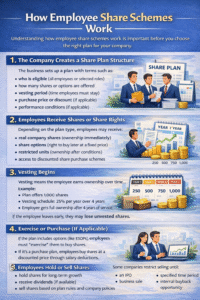
Understanding how employee share schemes work is important before you choose the right plan for your company.
A typical employee share plan works in a structured way using clear rules and timelines.
Step 1: The Company Creates a Share Plan Structure
The business sets up a plan with terms such as:
- who is eligible (all employees or selected roles)
- how many shares or options are offered
- vesting period (time employees must stay)
- purchase price or discount (if applicable)
- performance conditions (if applicable)
Step 2: Employees Receive Shares or Share Rights
Depending on the plan type, employees may receive:
- real company shares (ownership immediately)
- share options (right to buy later at a fixed price)
- restricted units (ownership after conditions)
- access to discounted share purchase schemes
Step 3: Vesting Begins
Vesting means the employee earns ownership over time.
Example:
- Plan offers 1,000 shares
- Vesting schedule: 25% per year over 4 years
- Employee gets full ownership after 4 years of service
If the employee leaves early, they may lose unvested shares.
Step 4: Exercise or Purchase (If Applicable)
If the plan includes options (like ESOPs), employees must “exercise” them to buy shares. If it’s a purchase plan, employees buy shares at a discounted price through salary deductions.
Step 5: Employees Hold or Sell Shares
Once employees own shares, they may:
- hold shares for long-term growth
- receive dividends (if available)
- sell shares based on plan rules and company policies
Some companies restrict selling until:
- an IPO
- business sale
- specified time period
- internal buyback opportunity
Types of Employee Share Plans
There are different types of share plans, and each one serves a different business goal. The best plan for a company depends on factors like business size, valuation, growth stage, and employee retention strategy.
Let’s look at the most common types.
1. Employee Share Option Plans (ESOPs)
An Employee Share Option Plan (ESOP) is one of the most popular employee equity models—especially for startups and fast-growing businesses.
How ESOPs Work
Instead of giving shares directly, ESOPs give employees the option to buy shares later at a fixed price (called the “exercise price”).
Example:
- You grant an employee the option to buy 2,000 shares
- Exercise price: $2 per share
- After 3 years, company share value becomes $10
- Employee buys at $2 and gains value difference
Why ESOPs Are Popular
ESOPs are attractive because:
- employees benefit from company growth
- companies don’t need to give shares immediately
- it supports retention through vesting schedules
Best For
- startups
- growth-stage companies
- businesses with long-term scale plans
2. Restricted Stock Units (RSUs)
RSUs are another widely used share plan, especially in more mature companies.
How RSUs Work
RSUs are share promises that convert into real shares after vesting conditions are met.
The employee does not purchase shares. Instead, they receive shares once they complete required service time (and sometimes performance conditions).
Example:
- Company grants 500 RSUs
- Vesting period: 4 years
- Employee receives shares gradually each year
Benefits of RSUs
- employees receive shares without paying upfront
- lower risk than options (since value doesn’t depend on exercise price)
- good for long-term retention
Best For
- established companies
- growing businesses with stable share value models
- leadership and senior executives
3. Employee Stock Purchase Plans (ESPPs)
An employee stock purchase plan allows employees to buy company shares—often at a discounted price—usually through salary deductions.
This is one of the easiest ways to build employee ownership across a wide workforce.
How an Employee Stock Purchase Plan Works
Typically:
- employees enroll in the plan
- a fixed amount is deducted from salary monthly
- employees purchase shares at a discount (e.g., 10%–15%)
Why ESPPs Are Valuable
An employee stock purchase plan helps companies:
- offer ownership opportunities to more employees
- improve engagement across teams
- build long-term employee wealth
Employee Share Purchase Plan (Same Concept)
Many companies also call this an employee share purchase plan. In most real-world discussions, both terms are used to describe similar purchase-based share schemes.
So whether you say:
✅ employee stock purchase plan
✅ employee share purchase plan
Both relate to employee-friendly share purchasing programs.
Best For
- companies wanting broad employee participation
- businesses aiming for stronger loyalty and culture-building
- organizations with predictable share value systems
Implementing Employee Share Plans
Creating employee share plans is not just about offering shares. It requires planning, compliance, communication, and proper administration.
Here’s how businesses can implement share plans effectively.
1. Define Your Goal
Before choosing a share plan, clarify your objective:
- Do you want to retain key employees?
- Are you rewarding leadership?
- Are you building a long-term ownership culture?
- Do you want broad participation across teams?
Different goals require different plan structures.
2. Choose the Right Type of Share Plan
Pick the best structure based on business stage:
- ESOPs: best for growth and future value
- RSUs: best for stability and long-term rewards
- ESPP / employee share purchase plan: best for wide participation
3. Create Eligibility Rules
Decide who can participate:
- all employees
- only full-time employees
- leadership team only
- performance-based selection
Clear rules improve fairness and clarity.
4. Establish Vesting and Conditions
Define the vesting schedule and conditions such as:
- time-based vesting (e.g., 4 years)
- milestone-based vesting
- performance-based vesting
This helps the business control ownership distribution.
5. Plan Communication & Employee Education
Employee share plans only work well when employees understand them.
Companies should explain:
- how shares work
- how employees benefit
- vesting timelines
- what happens if they leave
- selling restrictions (if any)
When employees don’t understand a share plan, it loses motivational impact.
6. Maintain Ongoing Administration
A share plan requires continuous monitoring such as:
- employee participation tracking
- vesting schedules
- reporting and recordkeeping
- compliance documentation
Professional administration makes the plan smooth and scalable.
Tax Implications of Employee Share Plans
Tax treatment is one of the most important aspects of any employee share plan.
Tax rules can differ depending on:
- plan type (ESOP, RSU, employee stock purchase plan)
- timing (grant, vesting, exercise, sale)
- employee residency and income brackets
- local regulations
Common Tax Events in Share Plans
Here are typical points where tax may apply:
1. At Grant
Sometimes shares or rights are granted with immediate value. In some cases, tax considerations begin here.
2. At Vesting
When shares become legally owned by the employee, tax may apply because the employee has received a real financial benefit.
3. At Exercise (Options)
For ESOPs, tax may apply when:
- employee purchases shares at exercise price
- market value is higher than exercise price
4. At Sale
When employees sell shares and profit from the increase in value, capital gains tax may apply depending on local law.
Why Businesses Must Plan Taxes Carefully
Poor tax planning can create:
- unexpected tax burdens for employees
- compliance risks for the company
- confusion during share payouts or exits
That’s why companies should always include tax guidance when implementing share plans.
Conclusion
Employee ownership is no longer just a trend—it’s becoming a strategic advantage for modern businesses.
A well-designed employee share plan can:
✅ attract better talent
✅ retain high performers
✅ align employee motivation with business success
✅ build long-term loyalty and culture
✅ reward employees beyond salary and bonuses
Whether your business chooses ESOPs, RSUs, or an employee stock purchase plan, the goal remains the same: creating a workplace where employees feel valued, motivated, and connected to the company’s growth.
If your business wants to grow while keeping its strongest talent committed for the long term, investing in employee share plans can be one of the most impactful decisions you make.
FAQs
What are employee share plans?
Employee share plans are programs that allow employees to receive shares, share options, or discounted share purchases as part of their compensation and long-term benefits.
How does an employee stock purchase plan work?
An employee stock purchase plan allows employees to buy company shares, often at a discounted price, usually through salary deductions over time.
What is an employee share purchase plan?
An employee share purchase plan is a type of share plan where employees purchase shares directly, typically at a discounted rate. It is similar to an employee stock purchase plan.
What are the main types of share plans?
Common types of share plans include:
ESOPs (Employee Share Option Plans)
RSUs (Restricted Stock Units)
ESPPs (Employee Stock Purchase Plans)
What are company secretary responsibilities in share plan governance?
While the primary role of share plan administration varies, company governance teams often help maintain records, ensure compliance, and document plan approvals.
Are employee share plans only for large companies?
No. Employee share plans are used by startups, SMEs, and large businesses. Startups often use ESOPs, while mature companies may use RSUs or employee stock purchase plans.