

HR strategy has become a core driver of business value, especially as organizations prepare for 2026’s uncertain economic, technological, and talent landscape. Instead of focusing only on administration, leading HR teams are building strategic plans that connect people, processes, and technology directly to measurable business outcomes such as growth, efficiency, and innovation.
What Is an HR Strategy?
An HR strategy is a high-level, written plan that defines how an organization will attract, develop, engage, and retain people to achieve its business goals. It acts much like a business plan for the HR function, clarifying priorities, initiatives, and metrics so HR can move from reactive problem-solving to proactive value creation.
A key distinction is that HR strategy is not the same as day-to-day HR operations. Operations focus on activities such as payroll, benefits administration, and basic compliance, while HR strategy focuses on long-term talent planning, capability building, and aligning the workforce with future business needs. When HR operates strategically, routine tasks are increasingly automated or streamlined, freeing capacity for higher-value work.
Key Elements of an HR Strategy
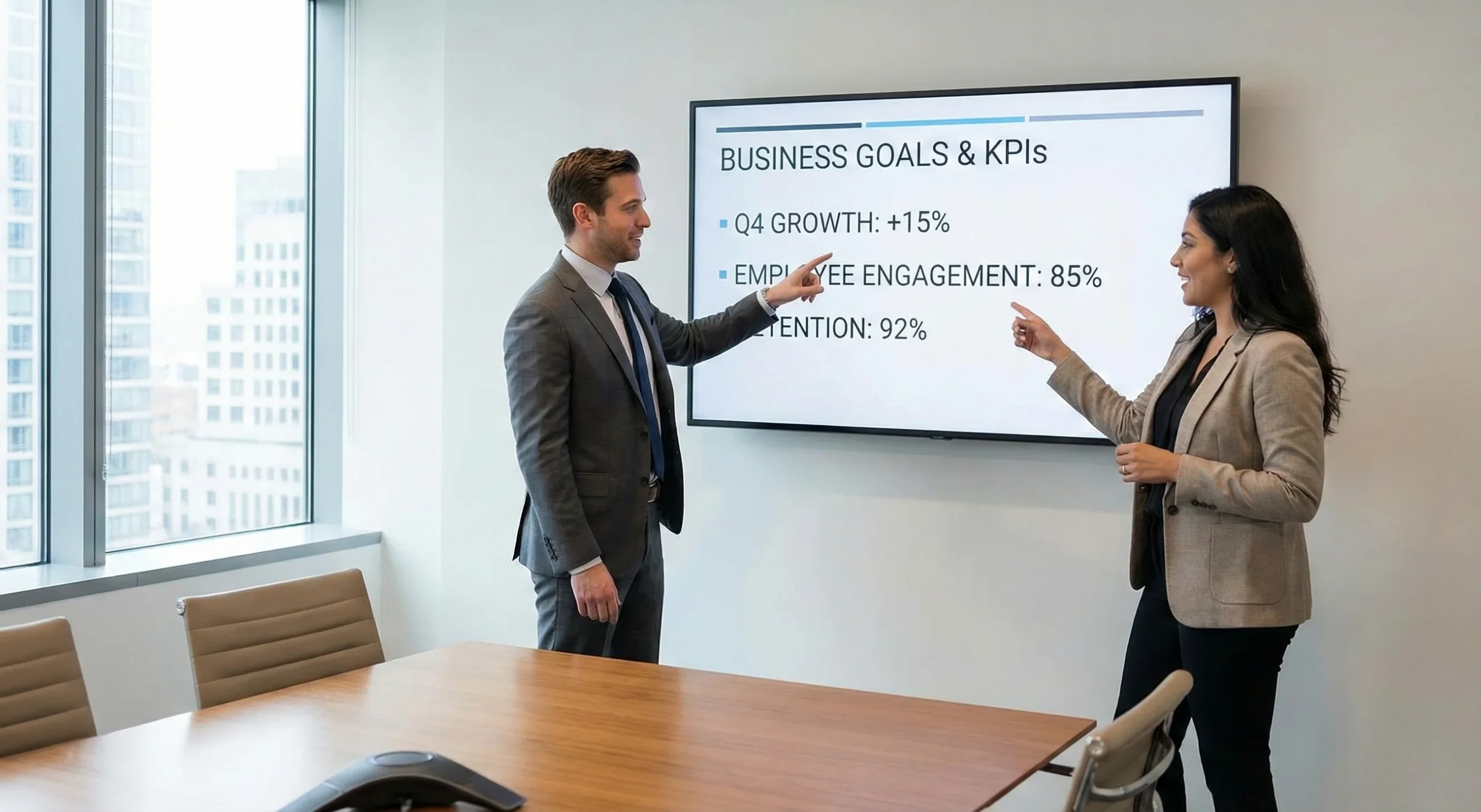
A comprehensive HR strategy brings several interconnected components together so they support the same business direction. Each element reinforces the others and should be grounded in data, not assumptions.
Business Goal Alignment
Business goal alignment means that every major HR initiative clearly supports a defined company objective, such as revenue growth, market expansion, customer experience improvement, or cost optimization. This typically starts with understanding the corporate strategy, then translating it into people-focused objectives like building new capabilities, reducing turnover in critical roles, or improving leadership effectiveness.
When alignment is strong, HR can show how initiatives such as leadership development, workforce planning, or technology investments contribute to measurable outcomes, such as lower hiring costs or faster time-to-productivity.
- Link each HR initiative to a specific business KPI (e.g., sales growth, margin, NPS).
- Prioritize HR projects based on their expected impact on these KPIs.
- Regularly review business strategy shifts and update HR plans accordingly.
Talent Acquisition
Talent acquisition focuses on how the organization attracts, sources, assesses, and hires the right people at the right time. In 2026, this increasingly involves a mix of employer branding, data-driven sourcing, and streamlined hiring processes to reduce time-to-hire while improving candidate quality.
A strategic talent acquisition approach prioritizes roles that have the greatest impact on performance and risk, such as revenue-generating or hard-to-fill positions, and aligns workforce planning with anticipated growth or transformation projects.
- Define critical roles and skills based on business priorities.
- Invest in employer branding across job boards, social platforms, and review sites.
- Use structured interviews and assessments to improve hiring decisions.
- Track metrics like time-to-fill, quality-of-hire, and source effectiveness.
Employee Engagement & Retention
Employee engagement and retention strategies aim to keep high-performing employees motivated, committed, and less likely to leave voluntarily. Research consistently links higher engagement to better productivity, customer satisfaction, and profitability, making this a central focus of strategic HR.
Effective engagement and retention approaches go beyond pay alone, integrating recognition, meaningful work, career development, and strong manager–employee relationships. Feedback mechanisms such as engagement surveys and pulse checks help HR identify issues early and intervene before turnover spikes.
- Conduct regular engagement surveys and act visibly on the results.
- Build recognition programs that reward both performance and behaviors.
- Provide transparent career paths and internal mobility opportunities.
- Monitor turnover trends by role, manager, and demographic segment.
Learning & Development
Learning and development (L&D) ensures employees have the skills needed for current and future business requirements, particularly in areas like digital transformation, automation, and leadership. Organizations increasingly face skill shortages, making internal upskilling and reskilling a strategic necessity rather than a “nice-to-have.”
A robust L&D strategy aligns training programs with business priorities, uses modern learning methods (e.g., blended learning, microlearning, coaching), and provides pathways for high-potential talent to advance into critical roles.
- Identify current and future skill gaps through workforce and business analysis.
- Offer targeted programs (technical, soft skills, leadership) mapped to roles.
- Use mentoring and coaching to reinforce formal training.
- Measure impact using completion data, skill assessments, and performance outcomes.
Performance Management
Performance management aligns individual objectives with organizational goals and provides regular feedback to improve results and development. Many organizations have moved away from purely annual reviews toward more continuous, conversation-based approaches that better support agility.
Strategic performance management focuses on clarity of expectations, frequent coaching, and actionable, fair evaluations rather than compliance-driven documentation alone.
- Cascade organizational goals into team and individual objectives.
- Encourage frequent check-ins and mid-cycle feedback conversations.
- Use clear, behavior-based criteria to reduce bias.
- Link performance discussions to development and, where appropriate, rewards.
Succession Planning
Succession planning prepares identified employees to step into critical roles, especially leadership positions, when vacancies occur due to growth, movement, or unexpected departures. This reduces risk, speeds up transitions, and supports business continuity.
Strategic succession planning combines systematic identification of high-potential talent with structured development experiences, such as stretch assignments, cross-functional projects, and targeted training.
- Identify critical roles and potential successors for each.
- Use calibrated talent reviews to assess readiness and potential.
- Create development plans tied to real business assignments.
- Track bench strength and readiness for key roles over time.
Compensation & Benefits
Compensation and benefits strategies define how the organization rewards employees in a way that is competitive, equitable, and aligned with business performance. This includes base pay, variable incentives, benefits (health, retirement, well-being), and increasingly non-financial rewards such as flexibility and development opportunities.
Strategic reward systems support attraction, motivation, and retention while managing costs and ensuring fairness across similar roles and demographic groups.
- Establish a clear pay philosophy (e.g., lead, match, or lag the market).
- Conduct regular market benchmarking for key roles.
- Align incentives with measurable performance and company results.
- Communicate total rewards clearly so employees understand their package.
HR Technology & Data
HR technology and data sit at the center of modern HR strategy, enabling automation of routine tasks and providing analytics to support evidence-based decisions. Tools such as Human Capital Management (HCM) platforms, applicant tracking systems, and analytics suites help HR teams track metrics like turnover, headcount, pay equity, and time-to-hire in real time.
When used strategically, HR tech improves accuracy, speed, and transparency while enabling self-service for employees and managers. This allows HR to focus more on strategic work and less on manual administration.
- Implement integrated HR systems to centralize people data.
- Use dashboards to monitor key HR and business metrics.
- Automate high-volume processes like onboarding or payroll where possible.
- Ensure data quality and governance to enable trustworthy insights.
Types of HR Strategies

HR strategy can be viewed at two levels: an overarching, enterprise-aligned plan and more detailed functional strategies covering each major HR domain. Treating both levels intentionally helps ensure consistency and focus.
Overarching HR Strategy
The overarching HR strategy defines the big-picture direction for the HR function, tightly connected to the organization’s main business plan. It articulates the central people priorities—for example, becoming a “high-performance talent engine,” building a resilient workforce, or enabling digital transformation.
This overarching strategy sets the context and criteria for all HR decisions, guiding where to invest, which capabilities to build, and how to measure success over a multi-year period.
- Clarify the strategic role HR should play (e.g., growth partner, transformation enabler).
- Define 3–5 enterprise-wide people priorities for the next 2–3 years.
- Align these priorities with C-suite expectations and corporate strategy.
Functional HR Strategies
Functional HR strategies are more granular plans for specific areas like recruitment, learning, performance, or rewards, translating the overarching strategy into concrete actions. Each functional strategy defines objectives, initiatives, metrics, and accountability for that domain.
For example, if the overarching goal is rapid growth, functional strategies might include shortening time-to-hire, building a leadership pipeline, and implementing scalable HR technology. Together, these operationalize the broader intent.
- Create domain-specific strategies (talent acquisition, L&D, engagement, rewards, HR tech).
- Ensure each functional plan clearly connects back to the overarching HR priorities.
- Coordinate across functions so initiatives reinforce rather than conflict with one another.
How to Create an Effective HR Strategy in 2026

Building an HR strategy for 2026 requires a structured approach that blends business understanding, honest assessment, clear goals, and disciplined execution. The steps below reflect widely used best practices in strategic HR planning.
Step 1: Understand Business Goals and Context
The process starts with a deep understanding of the organization’s strategic direction, financial realities, and external environment. This includes growth plans, efficiency targets, market expansion, digital initiatives, and risk considerations such as regulation or talent shortages.
By engaging senior leaders early, HR can identify which people-related challenges are most critical—for example, scaling a sales team, improving leadership quality, or modernizing skills for new technologies.
- Review strategic plans, budgets, and key performance targets.
- Interview executives and business unit leaders about their top priorities and concerns.
- Consider external trends: demographics, labor market, technology, regulation.
Step 2: Audit Current HR Functions (SWOT Analysis)
A structured audit, often using a SWOT (Strengths, Weaknesses, Opportunities, Threats) framework, helps HR understand its current state and capability gaps. This includes processes, systems, service quality, skills within the HR team, and the employee experience across the lifecycle.
Collecting both quantitative and qualitative data—such as HR metrics, survey feedback, and stakeholder interviews—provides a realistic view of what’s working and what needs improvement.
- Review key metrics (turnover, time-to-hire, engagement, absenteeism, HR service levels).
- Map major HR processes and identify bottlenecks or manual pain points.
- Gather feedback from employees, managers, and executives on HR’s effectiveness.
- Identify internal strengths to build on and risks that require mitigation.
Step 3: Set Strategic HR Objectives (SMART Goals)
Strategic HR objectives translate business goals and audit findings into specific, measurable outcomes HR will drive. Using a SMART (Specific, Measurable, Achievable, Relevant, Time-bound) approach ensures clarity and accountability.
Objectives might include reducing voluntary turnover in critical roles, improving time-to-productivity for new hires, increasing internal fill rate for leadership roles, or enhancing engagement scores in targeted segments.
- Define a small set of high-impact objectives linked directly to business outcomes.
- Ensure each objective includes baseline measures and target values.
- Prioritize objectives based on value, feasibility, and resource availability.
Step 4: Develop Action Plans with Owners, Timelines, and Resources
Action plans describe how each strategic objective will be achieved, turning “what” into “how.” They list initiatives, tasks, responsible owners, milestones, and required budget or technology.
This step converts the strategy into an operational roadmap that HR teams and business stakeholders can follow and monitor.
- Break down each objective into specific initiatives and tasks.
- Assign clear ownership and cross-functional contributors.
- Set timelines, milestones, and success criteria for each initiative.
- Identify dependencies, risks, and mitigation plans.
Step 5: Secure Executive Buy-In and Communicate the Strategy
Executive sponsorship is crucial for resourcing, credibility, and change adoption. Presenting a concise, data-backed case that links HR initiatives to financial and operational outcomes helps gain that support.
Once endorsed, the strategy should be communicated clearly across the organization so managers and employees understand what is changing, why it matters, and how it affects them.
- Present the HR strategy to senior leadership with clear ROI logic.
- Refine the plan based on executive feedback and priorities.
- Communicate key elements through town halls, intranet posts, and manager briefings.
- Equip managers with talking points and FAQs to cascade the message.
Step 6: Track Metrics and Adapt Continuously
An HR strategy is a living document that must evolve as business conditions and workforce needs change. Tracking the right metrics and regularly reviewing progress enables evidence-based adjustments.
Dashboards and analytics help HR identify early signals—for instance, rising turnover in a specific role or low adoption of a new process—so corrective action can be taken promptly.
- Define a measurement framework with leading and lagging indicators.
- Review progress with business leaders at regular intervals.
- Adjust initiatives, resources, or targets based on insights and changing priorities.
- Document lessons learned to improve future strategy cycles.
HR Strategy Frameworks and Best Practices
Frameworks help structure thinking and ensure HR strategy is comprehensive rather than a collection of disconnected initiatives. They provide a common language for HR, leadership, and managers when discussing people-related priorities.
The 5 Ps of HR Strategy: Purpose, Principles, Processes, People, Performance
The “5 Ps” model organizes HR strategy into five interconnected dimensions that together create alignment and coherence.
- Purpose: The organization’s mission and vision, which define why it exists and where it is heading. HR strategy should reinforce this purpose through culture, capability building, and leadership practices.
- Principles: The values and beliefs that shape how people are expected to behave and how decisions are made, including diversity, equity, inclusion, ethics, and collaboration.
- Processes: The HR systems and workflows that bring strategy to life, such as recruiting, onboarding, performance reviews, and rewards.
- People: The skills, capabilities, demographics, and potential of the workforce; this includes how talent is acquired, developed, organized, and led.
- Performance: The metrics and outcomes that show whether HR strategy and initiatives are achieving their intended business impact.
Use of Data-Driven Insights and HR Technology
Data-driven HR uses analytics to inform decisions about talent, organization design, and investments. With modern tools, HR can move beyond descriptive reporting to predictive insights, such as identifying roles at high risk of turnover or the factors most associated with high performance.
- Build or adopt analytics capabilities within HR, including dashboards and reporting tools.
- Use data to test hypotheses (e.g., relationship between manager quality and turnover).
- Partner with finance and operations to link HR metrics to business outcomes.
Manager Empowerment and Clear Communication
Frontline managers are crucial in translating HR strategy into everyday behaviors, practices, and employee experiences. Without their buy-in and capability, even well-designed HR initiatives can fail in implementation.
Similarly, transparent communication about changes, expectations, and progress builds trust and reduces resistance, especially during periods of transformation.
- Provide managers with training on coaching, feedback, performance, and change leadership.
- Involve managers early when designing HR processes that affect their teams.
- Communicate regularly about what HR is doing, why, and how it benefits the business and employees.
Ongoing Evaluation and Refinement
Because market conditions, technology, and workforce expectations evolve, HR strategies must be reviewed periodically. Regular evaluation keeps the strategy relevant and allows the organization to capitalize on new opportunities or respond to emerging risks.
- Schedule annual or semi-annual strategy reviews with leadership.
- Compare results to original targets and reassess priorities.
- Sunset initiatives that no longer add value and redirect resources to higher-impact areas.
Examples of HR Strategies for 2026
Illustrative HR strategies help clarify how principles and frameworks translate into practice. While specifics vary by organization, the following categories are common focus areas for 2026.
Employer Branding & Talent Acquisition
An employer branding and talent acquisition strategy strengthens how the organization is perceived in the labor market and improves its ability to attract qualified candidates. It often combines internal culture improvements with external messaging and candidate experience enhancements.
- Optimize career sites, job descriptions, and social presence to reflect authentic culture and offerings.
- Encourage employee advocacy and manage employer review platforms.
- Simplify application and interview processes to reduce candidate drop-off.
Employee Engagement & Retention
This strategy reduces voluntary turnover and improves performance by creating a work environment where employees feel valued, heard, and supported. It often integrates recognition, feedback, flexible work options, and manager capability building.
- Implement regular listening mechanisms, such as surveys and focus groups.
- Develop targeted interventions for at-risk groups or critical roles.
- Support work–life balance and well-being initiatives where feasible.
Learning and Development
A learning and development strategy focuses on closing skill gaps and building future-ready capabilities. It helps organizations respond to new technologies, regulatory changes, and evolving customer expectations.
- Offer structured development paths for technical, professional, and leadership roles.
- Use on-the-job learning, projects, and rotations to reinforce classroom or online learning.
- Align content with strategic priorities, such as digital skills or customer-centricity.
Performance Management
A performance management strategy ensures that individual and team goals are aligned with organizational priorities while fostering growth and accountability. Many organizations are refining performance systems to encourage more frequent, meaningful conversations.
- Shift from purely annual reviews to ongoing check-ins and coaching.
- Ensure goals are specific, measurable, and connected to business outcomes.
- Train managers to provide constructive feedback and support development.
HR Technology & Transformation
An HR technology and transformation strategy focuses on modernizing systems and processes so HR can operate more efficiently and strategically. This often includes consolidating platforms, introducing employee self-service, and leveraging analytics.
- Evaluate current HR tech stack and identify gaps or redundancies.
- Implement integrated platforms that support the full employee lifecycle.
- Design change management and training plans to improve adoption.
Also Read: Top HR Trends 2025: Key Insights for Business Leaders
Benefits of a Strong HR Strategy
A well-designed HR strategy generates benefits that extend beyond the HR function and are visible in business performance. These benefits tend to reinforce one another over time, creating a positive cycle of capability building and results.
When HR initiatives are aligned and data-driven, organizations often see improved engagement, lower voluntary turnover, faster hiring, better leadership pipelines, and more efficient use of workforce costs. This, in turn, supports stronger financial performance, resilience in the face of disruption, and a better employer reputation in the market.
- Higher employee engagement and retention reduce hiring and onboarding costs.
- Better hiring and development improve productivity and innovation.
- Proactive workforce planning enables faster responses to market changes.
- Strategic use of HR technology improves efficiency and decision quality.
Conclusion
HR strategy is no longer a background document; it is a central lever for achieving business goals in 2026 and beyond. By aligning HR with corporate priorities, building robust functional strategies, and using data and technology to guide continuous improvement, organizations can turn their people strategies into a powerful competitive advantage.